

Best Construction Project Management Software 2026
Introduction
Finding the construction project management software that fits a company’s needs is hard. There are dozens of options, and the right choice depends less on features than on the size and type of projects you run. A five-person residential crew and a general contractor managing fifty concurrent commercial jobs need very different tools.
Construction software earns its place by improving communication and collaboration, centralizing document management, tracking project metrics for better risk management, and automating the work that slows teams down. Done well, it helps projects finish on time, within budget, and to the quality standard expected.
This article presents the strongest construction project management software available in 2026, grouped so you can jump straight to the platforms that fit your operation.
Stop wrestling with Primavera XER schedules.
Your team can see your schedule without buying a P6 license.
Start Free Trial No credit card · Windows & Mac · From $344/yr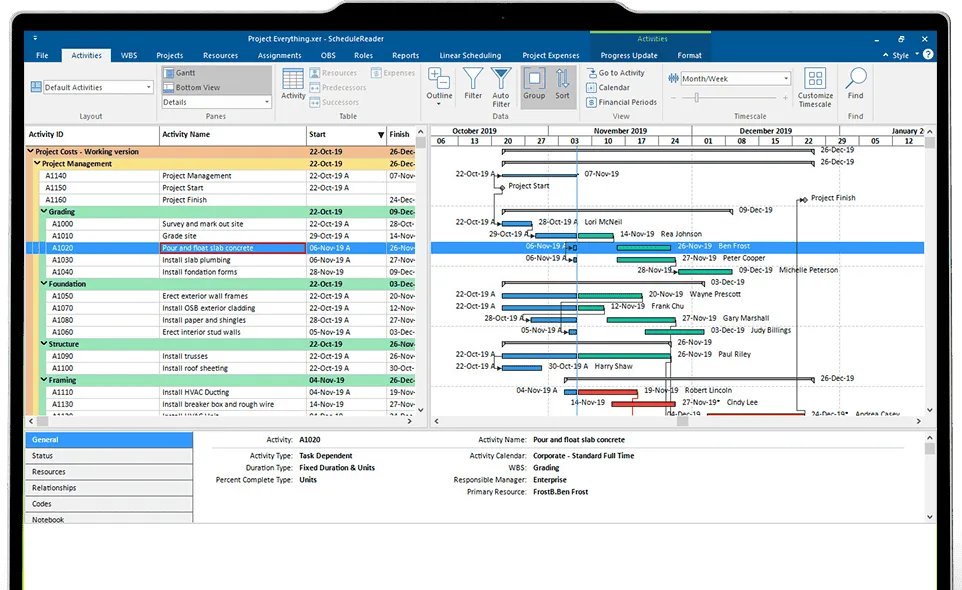
Quick picks: the best construction software by segment
| If you need… | Look at |
|---|---|
| A big commercial platform for an enterprise GC | Procore, Autodesk Forma |
| CPM scheduling and project controls for large programs | Oracle Primavera P6 |
| To view and analyze a P6 schedule without a P6 license | ScheduleReader |
| Field-first tools for the jobsite | Fieldwire by Hilti, Raken |
| Residential and remodeler workflows | Buildertrend |
| An affordable all-in-one for small-to-mid contractors | Contractor Foreman, JobTread |
| General work management for mixed teams | Monday, Wrike, Smartsheet |
Best construction project management software for 2026
Managing a construction project means keeping track of costs, time, quality, changes, risks, and progress. Project managers manage subcontractors, billing, and closeout, and they often help with bidding and proposals. Construction project management software keeps that whole range of operations in order. Let’s explore the top solutions for 2026.
- ScheduleReader gives teams dynamic, view-only access to XER and XML schedule data, which suits quick audits of any project and different types of analysis. It tracks project progress and offers a two-way collaboration channel through the Progress Update feature, letting field members send status updates to schedulers who keep the schedule current. Its interactive views and filters make it a stronger way to communicate project data than distributing a static PDF, and the PRO version adds report generation, schedule quality analysis, and time-location charts for linear projects. (ScheduleReader is our own product. It is a schedule viewer and analyzer, so it complements the project management platforms below rather than replacing them.)
- Oracle Primavera P6 is recognized as a leading tool for planning, managing and executing projects, programs and portfolios. It supports small projects while remaining powerful enough for the largest, most complex ones, and it is used across construction and engineering, oil and gas, energy, industrial manufacturing, aerospace and defense. For organizations that plan to move P6 to the cloud, Oracle now offers an automated migration path to Oracle Primavera Cloud.
- Procore is the enterprise standard for construction project management, with a financial management module for fully integrated delivery. It covers quality control, safety, design coordination and Building Information Modeling (BIM), and it connects projects through one of the deepest integration libraries in the industry, with more than 500 tools. Procore does not publish list pricing, and reported annual contracts run from roughly $10,000 upward depending on construction volume, which places it firmly in the mid-to-large contractor market.
- Autodesk Forma (formerly Autodesk Construction Cloud) is purpose-built for teams that run design and construction in one connected environment. It links Autodesk’s design tools, including Revit and Navisworks, into a single workspace where model clashes, RFIs and submittals move between teams without manual handoffs. It ranks as G2’s top-rated construction project management solution and is the natural fit for design-build firms, VDC teams, and any operation with a significant BIM investment. Pricing is by custom quote.
- Fieldwire by Hilti is a cloud-based, field-first solution for all types of construction businesses. Teams create tasks, view plans and work through digital punch lists, which saves time on site and in the office. Keeping documents in one place promotes transparency with clients through timestamps, change orders, and RFIs on request. A free tier covers up to five users, with paid plans reported from about $44 per user per month.
- Raken is a mobile-first platform for field reporting and jobsite compliance. It simplifies daily progress documentation, safety tracking and communication from the field, which makes it a common companion to a heavier office-side platform rather than a replacement for one.
- Buildertrend is a cloud-based project management platform built for residential builders, remodelers and mid-size contractors. It improves efficiency in building processes, reduces delays and communication errors, and includes estimating, scheduling, change order management, client communication and document management. Its client portal, where homeowners track progress and approve selections, is the standout feature for residential work, with plans reported around $600 per month.
- Contractor Foreman is tailored for small and medium-sized businesses across residential and commercial sectors, including trade and general contractors. Positioned as an all-encompassing solution, it offers more than thirty-five features across its subscription plans, with reported pricing from about $49 per month for up to three users.
- JobTread is built for small contractors who need affordability and ease of use over feature breadth. It focuses on estimating, invoicing, project tracking and team scheduling without enterprise overhead, and its rapid adoption among cost-conscious contractors is reflected in a #1 ranking on Software Advice and a place on the 2025 Deloitte Technology Fast 500. Plans are reported from about $40 per month.
- Monday, Wrike and Smartsheet are versatile work management platforms that construction companies and subcontractors often adopt for mixed teams. They lack deep industry-specific features, but they bring flexibility, ease of use, affordability, and strong task, scheduling and reporting capabilities, along with a growing set of AI-assisted features.
Depending on the company’s needs and preferences: Oracle Primavera P6 and Procore lead the enterprise project management domain, while ScheduleReader is the leading viewer for project plans, offering a dynamic way to view XER and XML schedules. For small to medium construction projects, the strongest choices are Fieldwire, Contractor Foreman and Buildertrend. If being web-based and supporting mixed methodologies is the deciding factor, Monday, Wrike and Smartsheet are the top three in that category.
How to choose the best software for your company
When selecting the best software for your company, weigh several key criteria:
- Features, pricing, value, and performance: Evaluate the software on its features, pricing plans, overall value, and performance. Look for essentials such as scheduling, document management, and communication tools, confirm the pricing fits your budget, and check it runs without compromising speed or reliability.
- Project size: Consider your projects in terms of duration and budget. Check whether the software scales from a small renovation to a large construction program, and whether the pricing structure flexes with the scope of each project.
- Project complexity: Assess the number of stakeholders, the complexity of the tasks, and the level of coordination required. Choose software with advanced scheduling, resource allocation, and risk management features to match that complexity.
- Project importance: For critical, high-visibility projects, prioritize reliability, security, and advanced collaboration. Favor software with a proven record on similar projects to protect your reputation.
- Segment fit: Match the tool to how you work. Enterprise commercial work points to Procore or Autodesk Forma; residential points to Buildertrend; small contractors get the best value from Contractor Foreman or JobTread; large-program scheduling points to Primavera P6.
Evaluating these criteria against your own projects is the most important part of the decision, so the software you choose aligns with your goals and supports successful delivery.
Conclusion
Construction project management software brings benefits that touch every stakeholder, the project’s success, internal operations, and the company’s reputation. The most important ones:
- Improved efficiency: Streamlined communication, automated workflows, and centralized project information speed up execution.
- Enhanced collaboration: Collaborative features improve teamwork across stakeholders, which reduces errors and shortens problem resolution.
- Cost savings: Optimizing resource allocation, minimizing delays and preventing rework keeps projects within budget.
- Time savings: Automated processes, real-time updates and intuitive interfaces help teams finish tasks faster and hit deadlines.
- Quality control: Built-in quality assurance helps teams deliver to a higher standard, which lifts client satisfaction and reputation.
- Risk mitigation: Risk tools help teams identify, assess and mitigate issues before they cause disruption or financial loss.
- Scalability: As projects grow, construction software scales to meet changing requirements.
- Competitive advantage: Better project management processes win and retain more lucrative work.
The market is moving quickly. The global cloud construction software market is growing at roughly 9.7% a year and is projected to reach $5.8 billion by 2032, and in Capterra’s construction management directory 91% of users rate project management capabilities as critical, with 83% saying the same about document management. Choosing a platform that fits your segment today, and can scale with you tomorrow, matters more than any single feature list.
Frequently asked questions
What is the best construction project management software overall?
There is no single best answer. Procore and Autodesk Forma lead for enterprise and BIM-heavy work, Buildertrend leads for residential builders, and Contractor Foreman and JobTread lead on value for small contractors. Match the platform to your segment first.
What is the most used construction project management software?
Procore, Buildertrend and Autodesk Construction Cloud (now Autodesk Forma) are among the most widely used platforms by construction project managers.
What is the best construction software for small contractors?
Contractor Foreman and JobTread are the strongest value picks, with reported pricing from roughly $49 and $40 per month respectively. Fieldwire offers a free tier for up to five users if field tasks and plan viewing are the priority.
How much does construction project management software cost?
It ranges widely. Small-contractor tools start under $50 per month, mid-size platforms like Buildertrend and Fieldwire run into the hundreds per month, and enterprise platforms such as Procore and Autodesk Forma use custom quotes that commonly start around $10,000 or more per year.
Do I need Primavera P6 to open a P6 schedule?
No. Schedules exported as XER or XML files open with standalone viewers such as ScheduleReader, which lets team members without a P6 license view and analyze the schedule.