
Understanding The Baseline Execution Index (BEI)
The Baseline Execution Index is a useful schedule performance metric that helps project teams measure how effectively planned activities are being executed.
BEI gives you a clear, numerical indicator of execution performance. It answers a simple question: Are we completing the work we planned to complete?
BEI is calculated with the following formula:
Stop wrestling with Primavera XER schedules.
Your team can see your schedule without buying a P6 license.
Start Free Trial No credit card · Windows & Mac · From $344/yr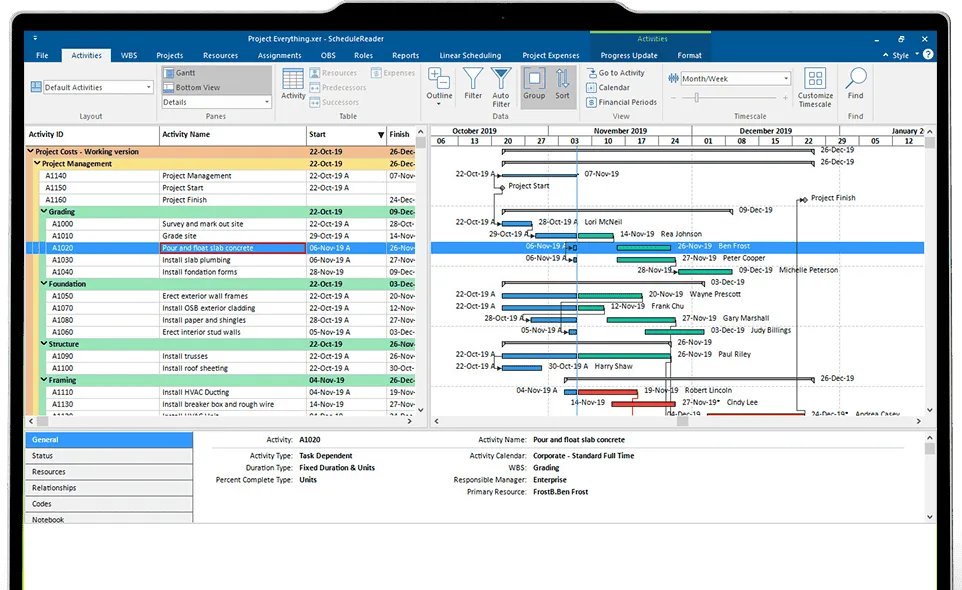
Number of Activities Completed) / (Number of Activities Planned to be Completed)
The results can provide different values that indicate:
- A BEI value of 1.0 means that we are on track and that the project is progressing according to the plan
- A BEI value lower than 1.0 means that we are falling behind schedule.
- A BEI value greater than 1.0 means that we are ahead of schedule.
Let’s look at a simple example.
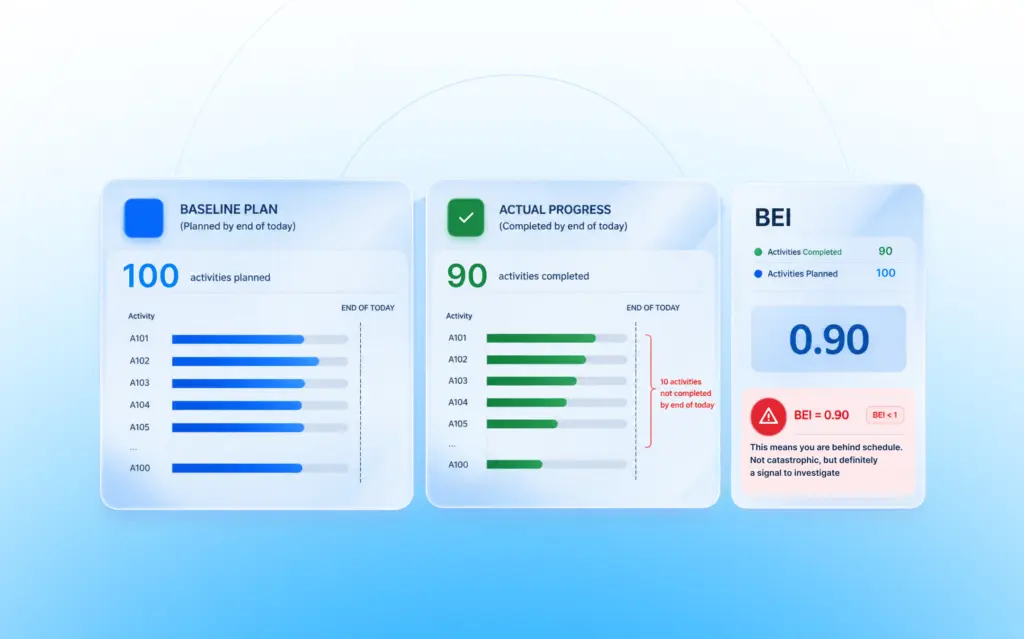
In the baselines schedule, 100 activities were planned to be completed by end of today.
In reality, you only completed 90 activities.
This means that your BEI is 90 / 100, which gives a value of 0.90, hence it alarms you that you are behind schedule. Not catastrophic, but definitely a signal to investigate.
How BEI Differs from Other Schedule Metrics
It’s easy to confuse BEI with metrics, especially with metrics like SPI (Schedule Performance Index.
The difference is that BEI focuses on activity completion, while SPI focuses on earned value (cost-weighted progress),
Think of it this way: SPI asks: Are we earning value as planned? BEI asks: Are we finishing the work we said we would?
Both matter. But BEI is often more intuitive, especially in construction, engineering, and Primavera-driven environments where activity tracking is key.
BEI and the DCMA 14-Point Schedule Assessment
If you have worked in scheduling, then you have likely come across the 14-point schedule assessment developed by Defense Contract Management Agency.
The DCMA 14-point assessment consists of a set of 14 checks used to evaluate schedule quality and health.
BEI is one of the core metrics within this framework.
A score of 0.95 or higher is generally expected to pass the schedule health checks.
Simple Way to Calculate your Schedule’s Baseline Execution Index (BEI)
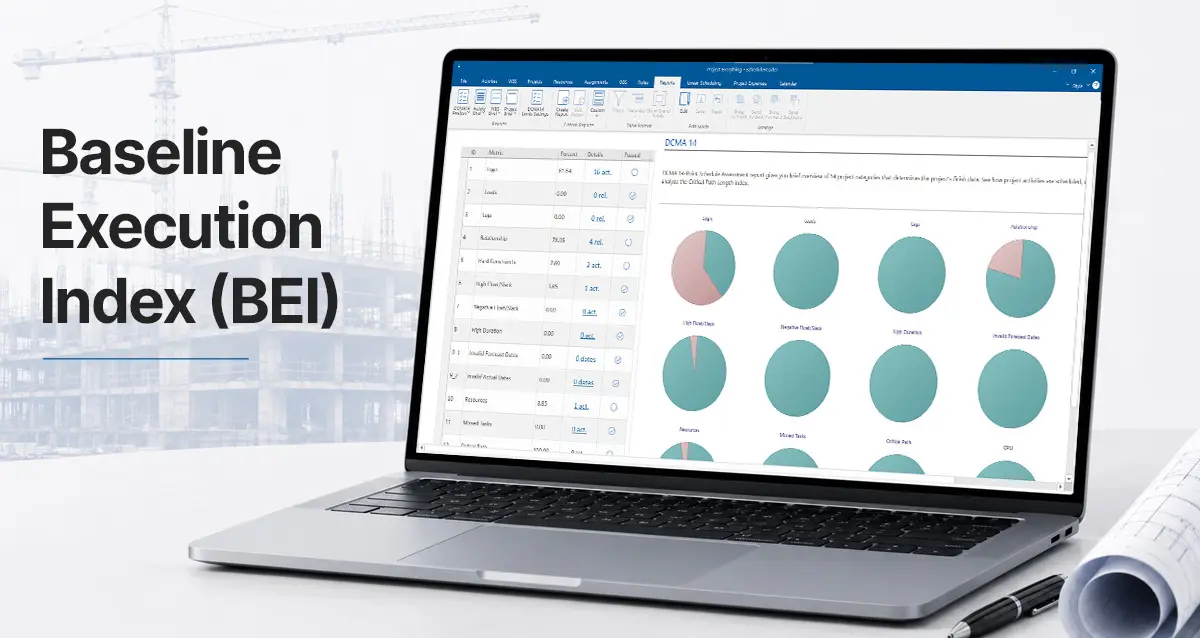
ScheduleReader PRO is equipped with a DCMA 14 schedule assessment report that includes a BEI calculation as one of the 14 metrics.
The report is quickly generated with a click of a button and a comprehensive dashboard with the results is provided to the user.
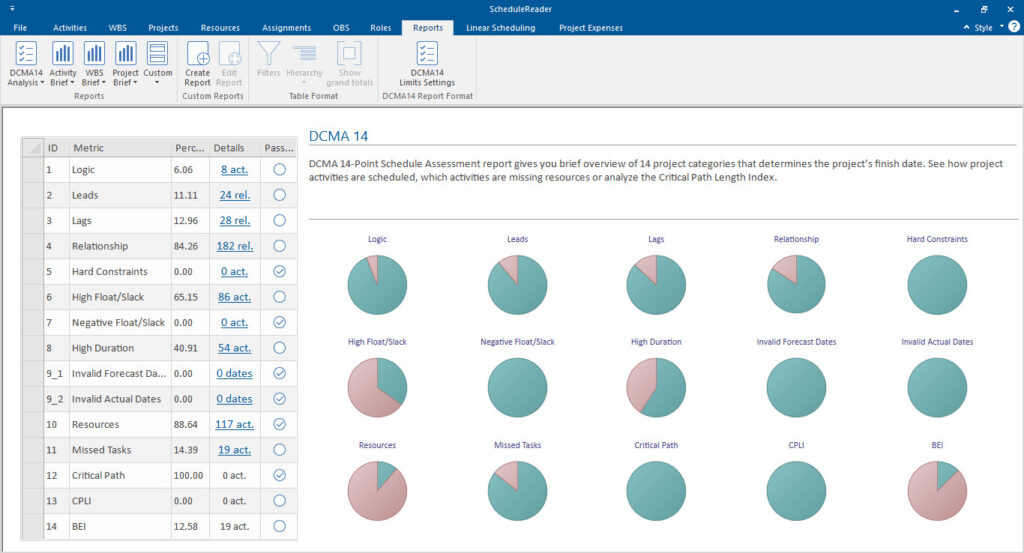
ScheduleReader reads your XER file’s baseline and current schedule data, identifying activities with a baseline finish date on or before the data date as “planned,” and activities marked as complete (typically with 100% progress or actual finish dates) as “earned.”
It is critical that the schedule is properly statused, with accurate actual dates and a valid baseline assigned, as BEI depends entirely on this data integrity. Activities missing baseline dates or improperly updated can distort the result.
Within ScheduleReader’s PRO DCMA 14 analysis, this calculation is automated and presented alongside other compliance metrics.
The report supports users to quickly assess whether the project is progressing as planned or falling behind.
ScheduleReader is available for download as a 15-day trial version, allowing you to start tracking your Baseline Execution Index in your next schedule update. Combine it with solid schedule analysis practices, and you’ll spot issues earlier, respond faster, and manage projects with greater confidence.
To learn more about the different licensing options visit the official pricing page.
Why BEI Is So Widely Used
BEI has become popular for several reasons.
It’s Simple and Practical
No complex calculations or advanced formulas are involved and anyone from planners to executives can understand it quickly.
It Reflects Real Execution
Schedules can look perfect on paper. BEI shows what’s actually happening on the ground.
If tasks aren’t completed as planned, BEI will reveal it. Fast.
It Provides Early Warning Signals
A declining BEI is often the first sign of trouble.
Before major delays appear, BEI starts slipping. That gives project teams time to act.
Recommended Practices for Using BEI Effectively
To get real value from BEI, you should maintain a realistic baseline schedule and ensure consistent status updates.
As BEI only tracks if a task is finished, not whether it was finished early, late, or if it lies on the critical path, you should use it alongside other metrics and combine these insights with schedule logic reviews.
In other words, treat BEI as part of a bigger picture and not as a standalone indicator. This is why a DCMA 14 analysis is useful.
Bringing It All Together
Baseline Execution Index (BEI) is one of the simplest, and most effective ways to measure schedule performance.
It doesn’t try to do everything. Rather it does one thing, very well: It tells you whether planned work is actually getting done.
In complex project environments, that clarity is invaluable and with ScheduleReader this information is instantly available at your fingertips.

The Synami team is the collective voice behind Synami’s project management solutions, providing guidance, tips, and industry expertise to help teams plan, manage, and deliver projects more effectively.