

See Linear Projects on a Time and Distance Axis
The Linear Scheduling View turns an existing .xer or P6 XML schedule into a time-location chart, so repetitive work reads as one picture.
How it works
A One-Page View of a Linear Schedule
Single-Page Overview
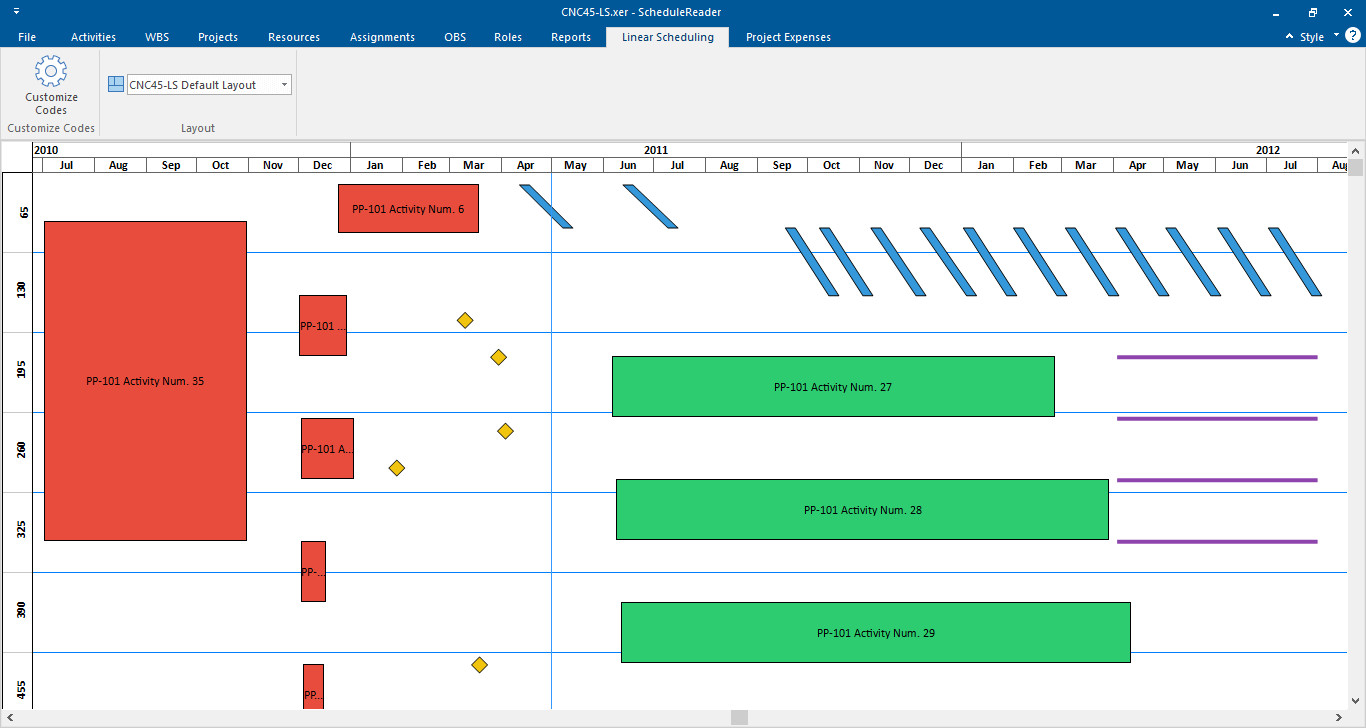
The Linear Scheduling View presents a visually simplified project in one page.
Time and Distance Axes
Activities are displayed along a time and distance axis, so repetition and sequence are easy to follow.
Conflicting Access, Seen Early
Geometrical shapes in different colors show the occupation of the work site over time, so conflicting access can be detected visually.
What you get
Linear Projects, Read from the Export
The Linear Scheduling View Pro
ScheduleReader displays a complete overview of a linear scheduled project from .xer and .xml files created in linear scheduling software such as Oracle Primavera P6.
- Activities along a time and distance axis
- Colored shapes showing work site occupation
- Introduced in version 7.0 of ScheduleReader
Typical projects
Where Time Chainage Diagrams Are Used
Time-location charts suit projects with repetitive activities, referred to as linear projects. They are common in civil engineering, construction and engineering, and power engineering.
- Highway and roads construction
- High-rise buildings construction
- Railway systems engineering and construction
- Tunnel construction
- Power line construction
- Oil and gas pipelines construction
The time chainage diagram is also known as a construction time chart, time-distance diagram, distance-time graph or time-location chart.
Getting started
How to Use the Linear Scheduling View
Import the Schedule
Open ScheduleReader and import your .xer or P6 XML project schedule with the linear planned project.
Open the Linear Scheduling View
Navigate to the Linear Scheduling View and read the project as a time-location diagram or time chainage chart.
Confirm the Required User-Defined Fields
To display as a time-location diagram, the file must contain three user-defined fields set by the scheduler: the Start and End points of the activities, and the Activity shape.
Why use it
Why Teams Use ScheduleReader for Linear Scheduling
See Complex Projects in One View
View linear project schedules created with the linear scheduling method through time-location charts in a single-page graphical overview.
Save Time, Software and Training
There is no need to learn and use separate linear scheduling software - ScheduleReader visualizes the project data already inside the .xer and XML schedules.
Communicate with Stakeholders
Give the whole team a clear, visual view of project status through time chainage charts and diagrams.
FAQ
Frequently Asked Questions
What Is a Time Chainage Diagram?
A time chainage diagram, also called a time-location chart, is a graphical representation of a schedule along a time and distance axis. It is used for linear projects with repetitive activities.
Which Editions Include the Linear Scheduling View?
The Linear Scheduling View is part of ScheduleReader PRO. It was introduced in version 7.0 of the software.
What Does My Schedule Need for the View to Work?
The project file must contain three user-defined fields set by the scheduler: the Start and End points of the activities, and the Activity shape.
Which Industries Use It?
Time-location charts are common in civil engineering, construction and engineering, and power engineering - for highways, high-rise buildings, railways, tunnels, power lines and pipelines.
Get started
Try ScheduleReader PRO Free for 15 Days
No obligation. Open a real .xer or P6 XML file, analyze it, then decide.