
Introduction
DCMA 14 Schedule Assessment is a project management framework for schedule quality control. The Defense Contract Management Agency (DCMA) proposed 14 points check protocol that should be used by all defense suppliers that are involved in multi-billion projects for aerospace and weapon systems. In this white paper we will give brief explanation for all 14 control criteria and why they are important for starting a well-scheduled project plan.
Check 1: Logic
The first check criteria from the DCMA 14 Schedule Assessment protocol is Logic. The Logic check ensures you that all activities in the project plan have predecessors and successors. The DCMA 14 Assessment recommends that maximum 5% from all project activities is acceptable to have a missing predecessor, successor or both. Most often, starting and finishing milestones belongs in this category of 5%, but there are project management techniques how to solve this issue and to decrease the percentage level. Unappropriated definition of predecessor-successor relations can make negative impact on project milestones dates.
Check 2: Leads
In Project Management practice, the term Lead is defined as overlapping time or negative lag, which is presented in days or hours between two project activities that have dependency. If lead is used, this means that the successor activity can start certain number of hours or days before its predecessor finish. Project Management software presents the Leads with negative number in the Lag’s column. DCMA is very restricted regarding the leads in project plan, outlining that no leads should exists. The reason for this statement is that lead affects the project Total Float and has impact on determining the Critical Path.
Check 3: Lags
By its definition, Lags are opposite to Leads. Lag is the time, presented in hours or days, between predecessor’s finish date and successor’s start date. DCMA is more flexible regarding the Lag, defining that 5% of total relationships in the project plan can have lags. Project practice recommends that instead placing lag in the relationship, to insert new task with explanation that it is substitute for lag. Like the Lead quantity parameter, Lag has impact on the Critical Path analysis.
Check 4: Relationship Types
Activities in the project plan are interconnected with different types of relationships, creating an activity chain. This activity chain was basis for inventing the Waterfall method, the most used methodology in the project management. There are four types of relationships in every PM software. DCMA stated that 90% of all relationships should be of Finish-to-Start type because using this type, the activity chain will be more clear and reasonable and the critical path, that emerges from it, will be simpler for analyzing and understanding. Project Managers should avoid the use of Start-to-Start and Finish-to-Finish dependencies in their projects and Start-to-Finish dependency to be used only in isolated cases.
Check 5: Hard Constraints
Constraint is activity’s characteristic that defines whether that particular activity will submit to the scheduling algorithm or not. There are two constraint categories: Hard Constraints (Mandatory Start and Mandatory Finish) and Soft Constraints (As Late As Possible, Start On, Start On or Before, Start On or After, Finish On, Finish On or Before and Finish On or After). DCMA requires 5% of all constraints used in the project plan to be Hard Constraints. Soft Constraints are more preferable for use because the scheduling algorithm compared to the Hard Constraints can manage them. Hard Constraints can cause scheduling problems.
Check 6: High Float
Float or slack is the amount of time, presented in hours or days, that activity can be delayed without obstructing the project milestones. DCMA defines the High Float as activity float with duration greater than 44 days. The maximum percentage of project activities that might have high float in one project is 5%. One of the reasons for having activities with high float is the lack of dependencies.
Check 7: Negative Float
Negative Float (or also known as Negative Slack) is the amount of time that one activity requires, beyond project schedule date. The reason for occurring in the project plan is that Hard Constraint (Mandatory Start or Mandatory Finish) is assigned to the activity, keeping it as much as possible in the future, causing some of the critical dates to be missed. DCMA states that no Negative Float should exists in the project plan.
Check 8: High Duration
Quality project manager will know the level up to which the decomposition of one activity will go. It is a tricky task that requires excellent knowledge of the process that is covered with the project, as well as skills and techniques for its creation. DCMA defines all uncompleted activities with duration longer than 44 days as High Duration activities. This type of task must not exceed the limit of 5% for one project.
Check 9: Invalid Dates
Although DCMA’s 14 check-points are applied before project’s implementation in order to see the project schedule status, there are several points that are performed during the plan’s execution. Invalid dates in the project plan are those forecast dates that are scheduled in the past or actual dates in the future, regarding the project data date. DCMA is very restricted concerning the invalid dates with statement that no invalid dates should exist in the project plan.
Check 9: Invalid Dates consists of two check-points: 9a for controlling the invalid Forecast dates (Early Start/Finish and Late Start/Finish Dates) and 9b for controlling the Actual Start/Finish dates. For 9a, the most common case for having invalid forecast dates is when the activity has negative float. Invalid Actual Start/Finish dates, i.e. 9b occurs when these dates are set in the future, beyond the project status date. Constant monitoring of these parameters during project progress can avoid these situations.
Check 10: Resources
Check 10: Resources check-point, requires that all activities in the project plan with duration equal or bigger than 1 day should have assigned at least one resource. Assigned resource can be from any type that P6 recognize: labor, cost or equipment. DCMA is very flexible regarding resources assignments because not all project activities can have resources from company resource pool. For example, some of the project activities depend from client’s decision (product or service revision made by the client). However, this check-point is good indicator to see if there are any activities that are unscheduled that can cause misbalance in resources allocation.
Check 11: Missed Tasks
The purpose of the 11th check-point is to measure the performance between the current project schedule and the original baseline schedule. Missed tasks in the project plan are those task which actual finish date is later than the earlier planned finish date. DCMA consensus is to have maximum 5% missing tasks in the project plan. When computing this number only completed activities are taken into consideration.
Check 12: Critical Path Test
The scope for this test is the critical path. The testing process is done in several phases: after determining the critical path, the .project manager extends the duration for 600 days on any activity that belongs to the critical path. Next step is to identify whether the project completion date is extended for the same amount of days. The project completion date can be presented through activity or milestone. Mismatching between the inserted and calculated duration indicates that some activities are missing predecessors/successors, causing the chain logic to be broken. In this case detailed project analysis is required.
Check 13: Critical Path Length Index (CPLI)
Critical Path Length Index is ratio of the sum of critical path length and project total float to the critical path length. This index presents the quality performance of the actual concept against the projected baseline. The critical path length is the duration, calculated in days, from the data date to the final project activity while project total float is the variance between the baseline finish date and forecast finish date. DCMA stated that CPLI should be 1, meaning that the project plan must be executed as it is planned. Only 5% variance is allowed.
Check 14 Baseline Execution Index (BEI)
The last check-point of the DCMA 14 Schedule Assessment is the Baseline Execution Index (BEI). This is another index that measures the performance of the contractor’s work on the project plan. It is calculated as ratio of the total number of completed activities versus activities that should be completed, in the period between baseline and actual schedule. If the target ratio is 1, then the activities execution is according the plan. Target ratio bigger than 1 indicates that the schedule is ahead of the schedule plan. If the index is below 95%, is considered as failure and future analysis is required.
DCMA 14 Schedule Assessment and ScheduleReader
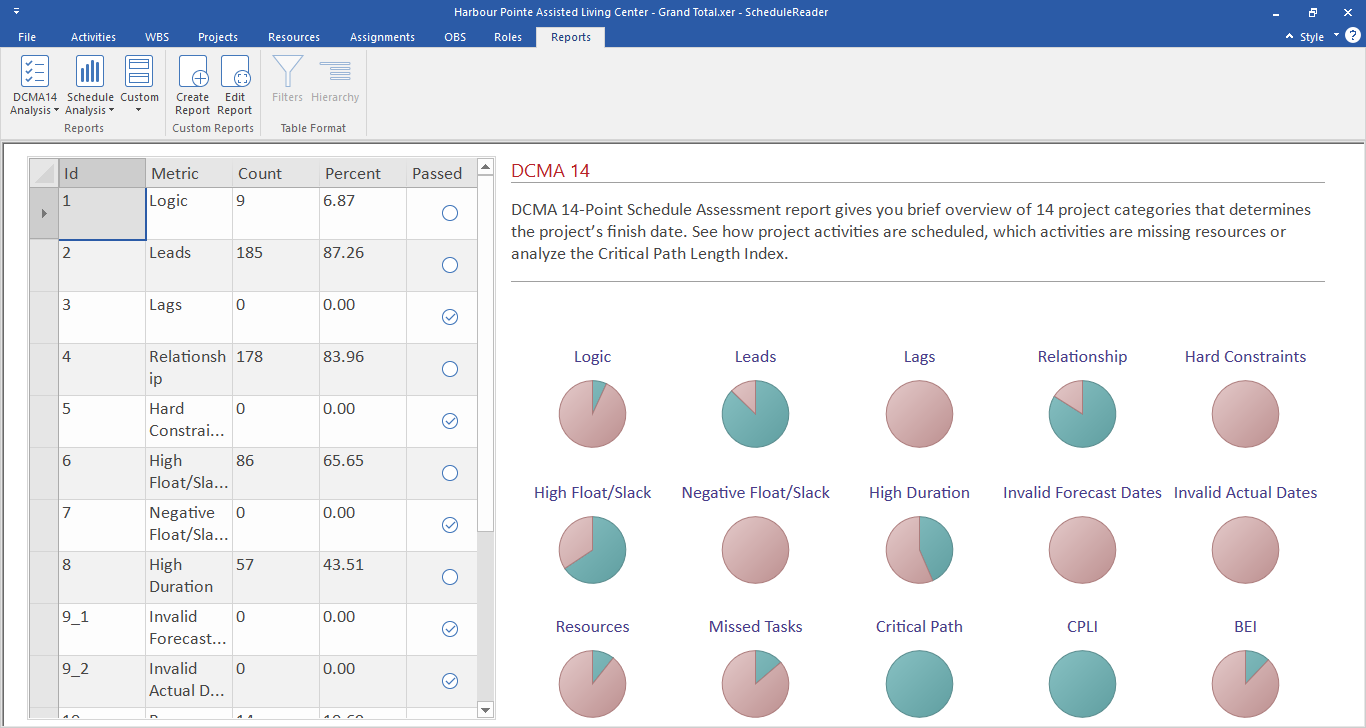
The short theory about the DCMA 14 Schedule Assessment described above, ScheduleReader visualize in one-page dashboard.
Accepting the DCMA 14 Schedule Assessment Dashboard functionality as a working tool, will improve your scheduling process and information exchange. Among the benefits that your company gains are:
- Suitability – scheduling information is presented in a way that is understandable by every project participants and PMO can help bringing business decisions in reasonable time, based on the presented information;
- Time saving – DCMA 14 Schedule Assessment graphical reports is created with one click of the button. In addition, user can print the report for management meeting or create more complicated reports and then exported it to the other project participants or team members;
- Less Effort – Usually creation of one reports require specific role in organization and can be time consuming. Changing the report’s components can be done quickly, by anyone and every report can be customized with less effort.
Benefits
DCMA 14 Schedule Assessment can be considered as schedule quality template for all projects in company’s portfolio.
DCMA 14 check-points can be established as practice before starting the project’s execution.
Project Manager will have full overview of the project schedule and the possible weak points.
Although it is not an industry standard, DCMA 14 can be considered as guideline for preparing and managing project plans.